Revenue management has long been the backbone of the travel industry. Airlines, hotels, online travel agencies (OTAs), and travel management companies (TMCs) have relied on it to maximize profitability by selling the right product to the right customer at the right time and price.
For decades, revenue management systems depended heavily on historical booking patterns, seasonal trends, and manual adjustments. While these methods served the industry well, today’s travel landscape is far more dynamic. Consumer behavior shifts rapidly, market conditions change overnight, and competition is only a click away.
This is where Artificial Intelligence (AI) is redefining the future of revenue management.
From Historical Data to Real-Time Intelligence
Traditional revenue management systems were built around historical data. Travel businesses would analyze previous booking trends, occupancy rates, and seasonal demand to forecast future performance.
These systems often struggled when faced with unexpected events such as changing traveler preferences, economic fluctuations, weather disruptions, or global events.
AI introduces a fundamentally different approach.
Rather than relying solely on historical trends, AIcontinuously analyzes vast amounts of real-time data to identify patterns, predict demand, and recommend optimal pricing strategies.
This enables travel businesses to react faster and make more informed decisions in an increasingly unpredictable market.
The Rise of Dynamic Pricing
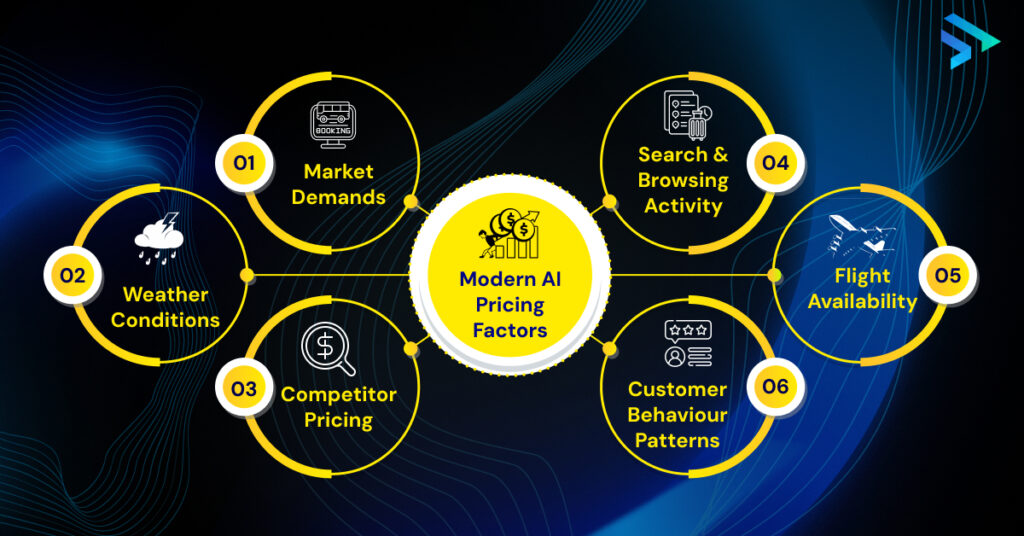
Modern AI-powered pricing engines can evaluate hundreds of variables simultaneously, including:
Market Demands
Weather Conditions
Competitor Pricing
Search and Browsing Activity
Flight Availability
Customer Behaviour Patterns
Instead of updating rates periodically, AI systems can make pricing recommendations in real time, ensuring travel providers remain competitive while maximizing revenue opportunities.
For airlines, this means more accurate fare optimization. For hotels, it results in better room inventory utilization. For OTAs and travel agencies, it enables smarter packaging and pricing strategies.
Predictive Demand Forecasting
One of the most significant advantages AI brings to revenue management is predictive forecasting.
Machine learning models can analyze millions of data points from multiple sources to anticipate demand fluctuations before they occur.
For example, AI can identify:
Emerging travel trends
Changes in booking windows
Demand spikes caused by events
Shifts in traveler preferences
Route and destination popularity
This predictive capability allows travel businesses to proactively adjust pricing, inventory allocation, and marketing campaigns long before demand changes become visible through traditional methods.
AI and Revenue Management for OTAs
Online Travel Agencies operate in one of the most competitive environments within the travel ecosystem.
AI enables OTAs to improve revenue management by:
Optimizing search result rankings
Predicting traveler intent
Delivering personalized recommendations
Dynamically adjusting commission strategies
Enhancing package pricing
Identifying high-converting customer segments
As traveler expectations continue to evolve, AI helps OTAs create more relevant experiences while improving conversion rates and profitability.
The Role of Generative AI and Agentic Systems
The next phase of revenue management extends beyond prediction and automation.
Generative AI and agentic systems are beginning to assist revenue managers by:
Generating pricing recommendations
Explaining demand fluctuations
Simulating market scenarios
Identifying revenue opportunities
Automating routine decision-making
Instead of spending hours analyzing reports, revenue teams can focus on strategic planning while AI handles data-intensive tasks.
As agentic AI continues to mature, revenue management systems may eventually evolve from recommendation engines into autonomous decision-making platforms operating within predefined business constraints.
What the Future Looks Like
Revenue management is moving toward a future where decisions are increasingly automated, predictive, and personalized.
We can expect to see:
Real-time pricing adjustments driven by AI
Hyper-personalized offers for individual customers
Autonomous revenue management systems
Greater integration between revenue, marketing, and customer experience functions
AI-powered forecasting that adapts instantly to market changes
Businesses that continue to rely solely on traditional revenue management practices risk falling behind competitors that can react faster and make smarter decisions through AI.
The future of revenue management is not simply automated. It is intelligent, adaptive, and increasingly autonomous. And that future is already here.
Revenue management is the process of optimizing pricing, inventory, and availability to maximize revenue by selling the right product to the right customer at the right time.
AI analyzes large volumes of real-time data to predict demand, recommend optimal pricing, and automate decision-making, helping businesses improve profitability.
Dynamic pricing is a strategy where prices are adjusted based on factors such as demand, competition, availability, and customer behavior to maximize revenue.
AI uses machine learning and predictive analytics to identify trends, anticipate demand fluctuations, and help businesses prepare for future market changes.