Most teams get this wrong. They either lock AI down so tightly that it becomes useless, or let it run unchecked and deal with the chaos later. Both approaches fail.
If you are serious about agentic coding, the challenge is not building AI systems, it is creating guardrails that keep them fast, useful, and under control. Because the moment your safeguards start slowing the system down, you lose the very advantage AI was meant to deliver.
What Are Guardrails In Agentic Coding
Guardrails are structured constraints that guide how AI agents behave. They are not there to restrict AI. They exist to make it reliable.
Good guardrails:
tell agents what they can and cannot do
reduce costly mistakes
remove uncertainty
make decisions faster
cut down the need for constant human intervention
Without guardrails, speed creates chaos. With guardrails, speed creates leverage.
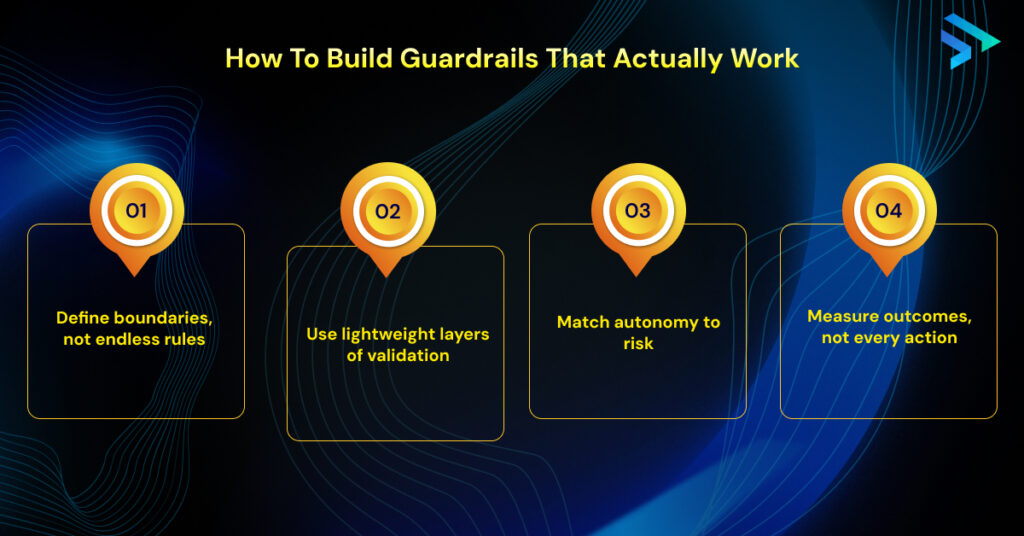
How To Build Guardrails That Actually Work
1. Define boundaries, not endless rules
Do not try to predict every possible scenario.
Just define:
what the agent can do
what it cannot do
when a human needs to step in
2. Use lightweight layers of validation
Forget giant approval processes.
Use multiple small checks instead:
syntax validation
automated tests
logic verification
security scanning
Small checks catch problems faster without slowing the system down.
3. Match autonomy to risk
Split tasks into categories:
low risk: high autonomy
medium risk: guided autonomy
high risk: human review
That keeps the system efficient and safe at the same time
4. Measure outcomes, not every action
Do not obsess over every click or every line of code.
Focus on what actually matters:
code quality
system stability
speed of delivery
reliability of output
If the outcome is strong, the process does not need to be micromanaged.
Why Startups Need Guardrails Even More
Startups love speed.
But speed without structure turns into technical debt, broken systems, and expensive rework.
The faster you move, the more important guardrails become.
The right guardrails let startups:
move quickly
keep quality high
avoid system drift
scale without chaos
Ironically, the teams moving fastest need the strongest foundations.
What Actually Works
The best guardrails are
invisible during execution
active during validation
adaptive based on context
This balance is what makes agentic coding sustainable, not rigid control, not complete freedom, but structured autonomy
Conclusion
Innovation is not limited by guardrails. It is limited by the wrong ones.
If your AI system depends on constant human intervention, it will never scale. If it operates without boundaries, it will eventually break.
The real advantage lies in building systems that move fast, stay controlled, and improve as they grow. That is what separates experimentation from real, scalable innovation.