Everyone in tech claims they’re “10x faster with AI” but most are still just vibe coding — prompting, hoping, praying, and manually stitching broken snippets together at 1 AM.
The industry doesn’t need better prompts. It needs agents that actually ship.
Welcome to the real transition happening right now the shift from vibe coding to agentic coding.
Industry Context: Why This Matters Now
For the past two years, AI in software development has mostly meant autocomplete, copilots, and clever prompting. Helpful, yes. Transformational, not really.
Developers still debug the same issues, write the same boilerplate, and chase the same integration bugs.
But something different is emerging.
AI coding agents that run tasks, not just generate text
Systems that read repos, plan changes, make PRs, self-correct, and retry
Autonomous software development loops that behave more like junior engineers than code suggestion tools
And this matters because startups are hitting the limit of vibe coding. The promise of “AI superpowers” clashes with the reality of messy codebases, evolving requirements, and the complexity of real production systems.
Agentic coding changes the game by giving AI persistent context, goals, and the ability to take action and not just produce vibes.
Core Insights: What Actually Works
1) Autocomplete Is Not Automation
Most teams assume they’re “using AI for development” because they use autocomplete or chat-based coding. But that’s just text generation with technical flavor.
Developer productivity tools are only transformational when they reduce cognitive load, not keystrokes.
2) Agentic Coding Works Because It Owns the Loop
AI coding agents don’t just write code—they handle the end‑to‑end loop:
Understanding requirements
Inspecting the repo
Planning the change
Executing the change across files
Running tests
Fixing errors
Creating pull requests
This autonomy creates a compounding effect.
The more the agent does, the more developers can focus on architecture, product decisions, and strategic work.
3) Real Leverage Is From Repo-Level Intelligence
Prompting a model with “write a function” is one thing.
Giving an agent full repo access—plus context on architecture, dependencies, tests, and conventions—is another.
Agentic systems produce code that fits your codebase, not generic boilerplate.
This is why they’re becoming essential for startups moving fast with evolving systems.
4) Vibe Coding Breaks at Scale
Vibe coding works early when:
The codebase is small
The architecture is simple
The team can tolerate rough edges
But as soon as you cross ~30k lines of code, vibe coding starts to crumble.
The model “hallucinates,” breaks interfaces, introduces regressions, or generates code that doesn’t compile.
Agentic coding thrives where vibe coding dies—because agents have plans, memory, and error‑recovery.
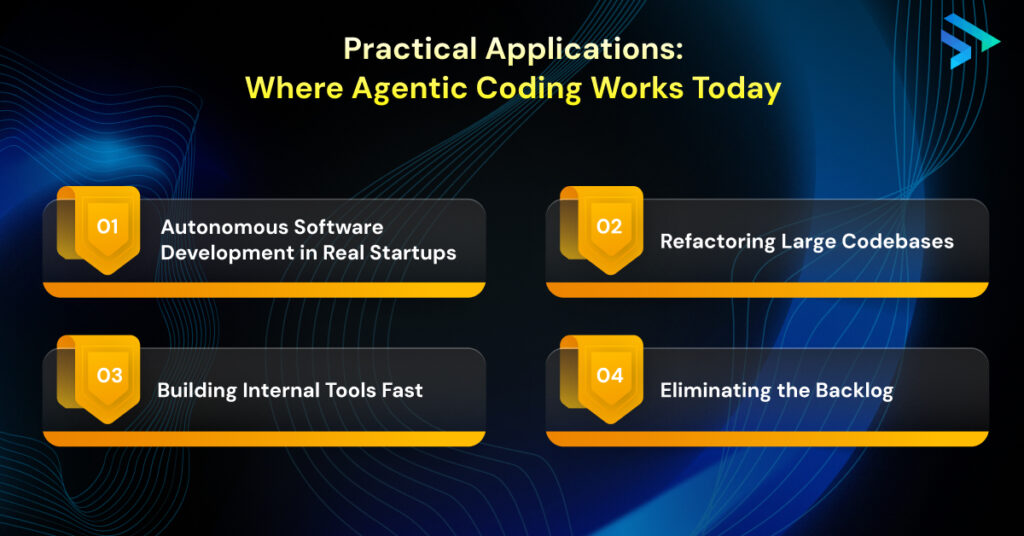
Practical Applications Where Agentic Coding Works Today
1. Autonomous Software Development in Real Startups
Autonomous software development is helping startups build faster with smaller teams. Using agentic coding, AI agents can generate code, run tests, fix bugs, and speed up deployments with minimal human input.
For startups, this means faster MVPs, quicker iterations, and lower development costs, turning AI from a coding assistant into an active part of the development team.
2. Refactoring Large Codebases
Agents can perform systematic, multi-file refactors without human babysitting:
Migrating from REST to GraphQL
Converting class components to functional ones
Updating design systems
Renaming models across the repo
Humans verify the PR. AI does the grunt work.
3. Building Internal Tools Fast
Need a new admin dashboard, script, or integration with Stripe or HubSpot?
An AI coding agent can build the first version in hours, not weeks.
4. Eliminating the Backlog
Agents are ideal for low-judgment, high-effort tasks:
Writing tests
Updating APIs
Cleaning dead code
Improving logging or telemetry
Every startup has 200 tasks like this.
Now they can be automated.
Challenges and Tradeoffs: The Parts No One Talks About
1) Autonomy Has Limits
Agentic coding works best when:
The system has tests
Requirements are clear
The architecture isn’t chaos
If your codebase is a maze of hidden dependencies and legacy hacks, even the best agent will struggle.
2) Agents Need Guardrails
Unlimited autonomy sounds cool until an agent renames every file in your repo because you wrote a weird prompt.
Healthy agentic systems use:
Sandboxing
Version branching
Automatic PR creation
Hard constraints and safety checks
3) Humans Still Own Direction
AI coding agents execute.
Humans decide:
What to build
Why build it
What success looks like
Agentic coding doesn’t replace developers.
It replaces the tedious 60 percent of the work that developers never enjoyed anyway.
Future Outlook Where Agentic Coding Is Headed
Over the next 24 months, agentic coding is poised to become as foundational as CI/CD or cloud hosting.
Expect to see:
AI-first development pipelines
Continuous autonomous improvement systems
Multi-agent architectures where one agent plans and others build
Goal-based development rather than task-based backlogs
The real revolution is not AI writing code.
The revolution is AI taking responsibility for outcomes.
Conclusion
Vibe coding gave us a taste of what AI could do.
Agentic coding is delivering what AI promised.
The teams that adopt AI coding agents today will move faster than teams that try to “get better at prompting.”
Because the future of software isn’t written by humans alone—or by human prompts.
It’s built by autonomous systems that work alongside us.