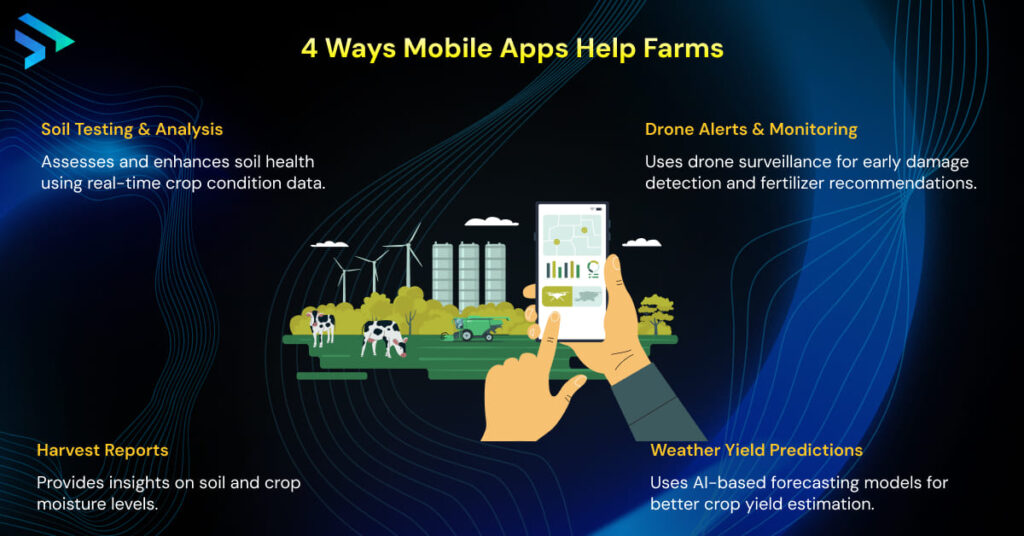
Leveraging Mobile Apps for Precision Agriculture and Crop Monitoring
Agriculture, one of the oldest industries in the world, is undergoing digital transformation. With precision agriculture at its core, this transformation focuses on improving farming practices using advanced technologies. Mobile apps are at the forefront of this shift, enabling farmers to monitor crops, manage resources, and make data-driven decisions.
Let us dive deeper into how mobile applications are shaping the future of farming, particularly in crop monitoring and precision agriculture.
Why Innovation Is Crucial in Agriculture
Traditional farming methods often involve manual effort and decisions based on intuition or historical data. However, in today’s world of increasing global food demand, unpredictable weather patterns, and shrinking agricultural resources, these approaches fall short.
Precision agriculture offers a solution by using real-time data, geospatial analysis, and advanced technologies to improve farming practices. Mobile apps are the tools that make these advanced techniques accessible to farmers, offering valuable insights right in the palm of their hands.
Key Features of Mobile Apps for Crop Monitoring
In today’s fast-evolving agricultural landscape, mobile apps have emerged as indispensable tools for farmers. With advanced capabilities and intuitive interfaces, these apps are transforming crop monitoring, helping farmers make data-driven decisions that improve productivity and sustainability.
Below are the key features of mobile apps for crop monitoring:
1. Remote Sensing Capabilities
Remote sensing has revolutionized the way farmers monitor their fields. Mobile apps use data from satellites, drones, and sensors to provide:
High-resolution imagery for detailed field analysis
Crop health monitoring through vegetation indices (e.g., NDVI)
Detection of anomalies, such as nutrient deficiencies or water stress
This feature enables farmers to identify and address problems across large fields quickly, improving efficiency and reducing the risk of crop loss.
2. Real-Time Weather Data
Weather plays a critical role in agriculture, and access to exact, real-time data is essential. Mobile apps provide hyper-local weather information, including:
Temperature, rainfall, and humidity levels
Wind speed and direction.
Weather forecasts for optimal planting, irrigation, and harvesting schedules.
Farmers can use these insights to mitigate risks associated with adverse weather conditions, such as droughts or storms, and plan farming activities more effectively.
3. Soil Moisture Monitoring
Healthy soil is the foundation of successful farming, and monitoring soil moisture levels is crucial for crop growth. Mobile apps integrate data from IoT sensors to:
Track real-time soil moisture across different field zones.
Provide recommendations for precise irrigation scheduling.
Prevent overwatering or underwatering, conserving water, and reducing costs.
This feature promotes efficient water management, ensuring crops receive the right amount of moisture for optimal growth.
4. Pest and Disease Detection
Pests and diseases are major challenges in agriculture, often causing significant crop losses. Mobile apps offer AI-driven pest and disease detection, allowing farmers to:
Identify pest infestations or disease symptoms by uploading photos.
Receive tailored treatment recommendations.
Access preventive measures to protect future crops.
Early detection helps reduce the need for extensive pesticide use, lowering costs and supporting sustainable farming practices.
What an Advanced Technologies Power Mobile Apps in Agriculture
Mobile apps use innovative technologies to provide accurate and actionable insights for farmers:
Artificial Intelligence (AI): Powers image recognition, predictive analysis, and decision-making support for farmers.
Internet of Things (IoT): Connects devices like soil sensors and weather stations to provide real-time data for monitoring.
Geospatial Technology: Provides satellite-based mapping for better land and resource management.
Blockchain Technology: Ensures transparency in the agricultural supply chain, helping farmers trace produce from farm to table.
These technologies, integrated into mobile platforms, enable seamless and scalable solutions for farmers worldwide.
Benefits of Using Mobile Apps for Precision Agriculture
Adopting mobile apps in farming brings a range of benefits:
Improved Yields: Early detection of issues and optimized farming practices lead to higher crop productivity.
Cost Efficiency: Farmers save money by reducing waste and using inputs like water and fertilizer more efficiently.
Sustainability: Better resource management helps minimize the environmental footprint of farming.
Accessibility: Mobile apps bring advanced technology to small-scale farmers, bridging the digital divide in agriculture.
Conclusion
Mobile apps are redefining precision agriculture by equipping farmers with the tools they need to succeed in an increasingly resource-constrained world. From real-time crop monitoring to predictive weather forecasting and resource optimization, these apps are empowering farmers to make smarter, faster, and more sustainable decisions.
As technology continues to evolve, the potential of mobile apps in agriculture will only grow, paving the way for smarter farming practices and ensuring global food security. By adopting these innovative solutions, farmers can achieve better productivity, reduced costs, and a sustainable future for agriculture.